27.9.14

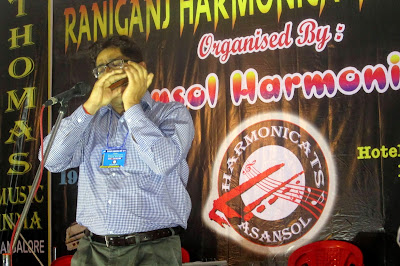
Bluesman of the North East : B.B. Hagjer

Dear harmonica lovers, our harmonica lover of this week is an Additional Commissioner of Taxes, Assam. When we talk about blues players from North  East, Mr B.B.Hagjer is one of the most discussed names in Indian harmonica lovers’ circle.


Given below is his write-up in his own words:

My journey with harmonica began when I first bought a Chinese ‘Tower’ harmonica for Rs.125/- way back in 1997 in Guwahati. Those days, harmonicas were not readily available. It was a chromatic harmonica and soon I started playing  a few numbers. I remember one of my favourites those days was ‘Boxer’ by Simon & Garfunkel. I also used to play a few Hindi Bollywood numbers and a few more Assamese numbers composed by Late Bhupen Hazarika. Someone from Mirza in Assam one Mr.Das  brought a neck rack for me from USA and I soon started playing harmonica on the rack. Those days diatonic harmonicas were not readily available. Then in 2002 I acquired my first diatonic harmonicas. These were Lee Oskar harmonicas in different keys. These days I play mostly Hohner and Suzuki harmonicas. One of my friends had brought them from USA. My early influence was definitely Neil Young. Even though I liked some of Bob Dylan Stuff, I preferred the likes of Neil Young more. I made my first western album titled ‘Our Land’ in 2004 and my second album titled Hunpori in Assamese in 2008. I have played harmonbicas in both the albums.  In my early days, I did not know what blues were or playing in second position meant. It was gradually that I learnt more about playing in 1st, 2nd, 3rd and 4th position on a diatonic harmonica. Started using internet only from 2007 and gradually the world of ‘Blues’ opened up and then  I came to know about legendary Little Walter, Sonny Boy Williamson II, Walter Horton, Sony Terry etc . Of the current lot, I am very impressed with Jason Ricci, Howard   Levy, Todd Parrot, Frenchman Sebastien Charlier. Among the ladies, it’s Rachel Plas, Christelle Berthon.

Asia Pacific Harmonica Festival I attended in Singapore in 2010 and Kualalumpur in 2012 was an eye-opener for me. Number of participants mostly the kids aged between 6-16 years and their expertise with the instrument amazed me. I found that the standard of harmonica playing especially chromatic is very high in South East Asia and neighbouring countries. Unlike in India, there are many harmonica teachers in South East Asia and harmonica education starts from very young age. Kids are ably guided by quality teachers with the knowledge of notations. The difference I find is that in India we play out of love for the instrument and are happy once some proficiency is achieved. If one attends a harmonica meet in India, one will usually find middle aged people taking part and very few kids aged below 10 or 15. There is not much competition. Unless kids are taught to play harmonica from a tender age, high degree of proficiency in playing harmonica cannot be achieved. Need of the hour is opening up more harmonica schools and holding competition among the kids.
I always felt the need of discussing nuances of playing diatonic players where I live; but there being hardly any diatonic harmonica player, I felt frustrated at times. Therefore when famous harmonica player Brendan Power visited India in 2011, I invited him to perform in Guwahati. He came to the city with Abe Thomas who is the moderator of Harmonica India. Brendan and company stayed in my residence.  Brendan was a revelation. I remember after picking him up at the airport, I was driving the car. Then he started playing the harp in the car itself and throughout the journey to my residence where he put up, I was foot stomping and tapping the dashboard vigorously. Brendan’s concert in Gymkhana club, Guwahati  was a sell-out. Well known Blues band ‘Soulmate’ also performed that day.


We know that there are missing notes in diatonic harmonica and unless one learns the advance technique known as overblow and overdraw, one cannot get the missing notes. Since 2009, I have been learning the advance technique and at present I can reasonably play the missing notes by employing the advance technique. Had there been no internet, it would have been very difficult for me to learn.  I have spent hours and hours learning to overblow and it was very frustrating at times not being able to play the notes. I have damaged/broken several reeds in the process, but it was worth it. But gradually, I leant how to overblow.
I had the opportunity of meeting several harmonica players in Delhi All India Harmonica Meet in 2013 such as Saitejas, Madan Kumar, Ashok Bhandari, Ramana, Anupam Paul, Debashis Dutta etc. There are more harmonica players, I could not interact with.  Saitaejas  came to my residence in Guwahati on his way back from Hornbill Festival, Nagaland. It was a pleasure meeting him and his initiative in teaching young children to play harmonica is the need of the hour. Among the diatonic players I have met Aki Kumar who is based in America, Vikash Karandikar, Ramasesh, Subham Harnal, Sridhar, Dileep Naik, Bob Lyndoh etc. Number of diatonic players in India is very small. While attending APHF also, I observed that there are not many diatonic harmonica players in Asia. Indonesia is however coming up with good diatonic harmonica players.  If we want to compete in APHF, we have to have high degree of proficiency in playing the harmonica and that is why exposure is required. I wish more Indians would attend APHF to experience and see the high standard of harmonica playing. Even though I have five-six Hohner and Suzuki chromatic harmonicas, I have stopped playing them. I am concentrating totally on playing diatonic harmonicas now-a-days.

Recently, Mr B.B.Hagjer visited The 10th Asia Pacific Harmonica Festival 2014 in Hangzhou, China.
HaLoH wishes Mr B.B.Hagjer a bright future in his future endeavors. 

We breathe harmonica!

27.4.14

Asansol Harmonicats host Raniganj Harmonica Meet 2014

This month on 19th April, Asansol Harmonicats hosted a harmonica meet at Raniganj (West Bengal) so as to enable the local harmonica players from Raniganj, Asansol, Kolkata and other parts of Bengal attend the programme conveniently. Raniganj is the hometown of ‘Harmonica Tiger-Swarup Mitra’. The harmonica lovers outside West Bengal were also welcome to join them.  The day-long programme was successfully attended by 55 harmonica players and the strength of the audience was around 70-80 persons.

Shri Vinayak B. (Vice President of Harmonica Lovers of Hyderabad-HaLoH) was the anchor of this programme. The programme started with the Lighting of Lamp by three junior as well as the most promising Harmonica players-Sumit Guha, Haimanti Karmakar and Ashay Kumar. This was followed by garlanding of the portrait of the ‘Father of Indian Harmonica’ - Late Shri Milon Gupta by Shri Asim Banerjee, who is an excellent harmonica player from Jamshedpur. Shri Vinayak B. and Shri Asim Banerjee are direct students of Milon da.

The programme was divided into three performance sections either on karaoke or accompanied with orchestra. In Pre-Lunch session, the beginners performed on stage. There were around 20 odd local students who performed on stage. This was followed by authentic Bengali lunch.
Post Lunch, the performances by harmonica players continued.  They included Haimanti Karmakar (student of Sandipan Chakraborty), Sumit Guha, Rabin Tah, Dr Ashish Goyal, Shri Kumar Auddy, Rajiv Shrivastava, Naren Jain, Shri S.G. Helkar, Rana Mukesh Singh and Dr Tapan Maharana. The session continued till tea break.

Post Tea-break, the most awaited performances were given by Sourab Debnath (student of Shri Swarup Mitra) from Asansol, Shri Ajay Vijh from Singrauli (played 2 Hindi songs), Shri Sumanta Basu from Kolkata (played around 5 Bengali numbers), Shri Swarup Mitra (played 2 Bengali and 2 Hindi songs) and Shri Asim Banerjee(played around 5-6 songs). Duet performance by Haimanti and her guru Sandipan was also enjoyed by the audience. Another highlight of the programme was a jugalbandi (jamming session) of harmonica and santoor by Dr Arindam Modak and Shri Swarup Mitra. During the programme, there was a special classical dance performance on Lord Krishna and Gopikas’ theme by the students of Sohini Dance Academy. This dance was choreographed by Mrs Swarup Mitra.


M/s Reynolds and M/s Thomas Music, Bangalore who deal in Hohner and Suzuki harmonicas respectively partly sponsored this event. Coca Cola sponsored the beverages.
At the end of the programme, Shri Vinayak B. received a standing ovation from the audience for his contribution towards the advancement of harmonica,his role in HaLoHandhis participation forthe success of this Meet. The local harmonica students got good exposure during the event. This boosted their confidence and zeal to learn harmonica. HaLoH wishes to see many such small local/state level Harmonica Meets all over India so that it motivates the present youth to pick up this wonderful little musical instrument.

(few videos will be published shortly)

We breathe harmonica!

26.3.14

NAKUL DHAGAT: My Harmonica Journey.

We are presenting a write-up on Dr Nakul Dhagat, who is a 50 yrs old passionate Harmonica Lover who works as Associate Professor (Architecture Dept.) in MANIT, Bhopal. He also trains his students in communication skills. He plays Bollywood music on harmonica and strongly believes that we should create interest in the younger generation towards Harmonica by playing contemporary music so that they relate themselves to it and get motivated to pick up this instrument. He feels that we have to create acceptability for the harmonica amongst a larger audience and a place for a Harmonicist in a band just like we have the same for a Guitarist or a Drummer who play important roles. He has successfully motivated his 14 yr old son to play the harmonica.

Here we go... Nakul Dhagat, in his own words...

As a child I was brought up on many a good things; tasty food, lots of love from my “ma”; good pampering from my brother and sisters; lots of creation and repair work from my father. And to top it all lots and lots of Hindi Film music from Vividh Bharti on All India Radio, which was played for the whole day in the house. Television was, fortunately, never a part of my upbringing till 1980. By that time another important thing had already entered my life. My black, double sided Tremelo Harmonica of Hero. This happened in 1974. I still remember the day. My dad came home from Gorakhpur by the morning train, and, as a kid, I was more interested in knowing what he got for me from there. In his unpacking, coupled with his talks with “ma”, he handed me a harmonica. I did not understand, then, what I had got. It was another thing with some limited life.
I left the room and things went on normally. My dad observed that I was not being respectful to the gift. So occasionally, he would pick it up himself and play some combination of notes. I do not remember the notes, but do remember this that it was the same combination all the times. I don’t remember what worked, but I also started doing the same; harping some combination of notes that sounded sweet to my ears. And one day, suddenly, this exercise made me play, accidently, the opening line of the song Ek mai aur ek tu” from the movie Khel Khel mei. This stared it all.

My vocabulary of songs was decent because of Vividh Bharti. Slowly I was picking up songs and playing them at home, school an, then, college. By this time I also had this impression that its only “Hero” which manufactured Harmonicas. In 1989- 90 I saw and acquired my first Chromatic from a street vendor in Sarojini market in New Delhi. It was a “Tower”. I played the instrument for a few years like a diatonic since I had no idea what to do with that slider. Slowly the instrument became part of that collection of things which were not in use. I came into my present job in the year 1991. A bad thing happened after that. I ignored my harmonica completely. It was collecting dust in my dark lockers.
Somewhere in 2004, I saw a Puck with Mr. Vijay Trivedi (member of Harmonica Passion Group of Bhopal) and bought it immediately. I saw his collection of Harmonicas and this started my interest in Chromatic Harmonicas. I forced my dad to “gift” me a good chromatic since they were costly. I got my first expensive harmonica, Chromonica 64 of Hohner. Holding it in my hand was a divine feeling. Being married for 14 years, I was again in “Relationship” with my harmonica ;).
My dad initiated the process and he was the one to push it further too. But the next big thing to happen in my harmonica life was the internet. Somebody told me that there are a lot of karaoke tracks and it was madness downloading them. Initially I got all the tracks in C scale. Favorite songs like “Aage bhi jane na tu”, “Ek pyar ka naghma hai”, etc. playing these gave the feeling of a performance long missed. This took further the search for more tracks.
My journey of learning harmonica was not just that of self exploration. Yes I did that also, coupled with lots of practice whenever time permitted; one song before going to bed, or few songs in the evening after coming back from office. I also took help of the experts in the field, contact with whom was, again, through internet. My first such talk was with Mr. Jagjit Singh Issar from Jammu. We talked for long time on phone. One mention from him made me curious. He told me that his son would change the pitch of a track for him. Searching on I could get Karafun and this was another leap. This further strengthened my relationship with harmonica.
I also try my hand at making small stuff and could not help, but making a few boxes to keep harmonica. I also made my set of tools to repair harmonica and was successful in replacing a reed with the help of these “home made” tools.


I must admit that every time I have talked to some harmonica player, a new learning came up and this helped me go further. Audacity, tapping of slider, playing single note, recording tips, equipments, repairs, etc. was learnt through such discussions. Three years ago, in 2010, we could collect as a group in Bhopal and formed the “Harmonica Passion Group”. We try to meet every Sunday morning to play songs for an hour or so and take stock of what we have learnt. Learning process since 2009 has been that of “distance learning”. The main thing, I understood, was to keep my ears and eyes open and catch every good learning that came my way. I took criticism with a pinch of salt; in the right spirit. If it invokes thoughts in me, it will also result in my growth.
In this journey with Harmonica, suddenly, I found my younger son Manas also walking next to me. This made me feel proud. Today this hobby takes some time of my day, but, in return, gives lots of satisfaction. I’m blessed that I have this hobby.

I would like to make a mention about my son Manas. He turned 14 this June 2013. How did he get into harmonica? Its hard to pin point that point in time. But it all happened in two phases. I remember having given him a harmonica, just to find it lying without use. I suppose he was either young for it, or did not have the interest. Then the phase came when I literally sat daily to practice songs with tracks. He would listen to me and he asked me for a harmonica. It seems he got interested and inquisitive if he could do the same. I gave him a Tower. This was somewhere in late 2011, early 2012. He started blowing notes out of interest and was able to pick up his first song on Harmonica "Aa chal ke tujhe". I recorded it and uploaded it. He felt good about it. This encouraged him. I would try to get as close as possible to the original notes in a song. I did not want to force the instrument on him and wanted him to have genuine interest. We sit together occasionally and practice songs. I try to correct his notes and techniques. Slowly he, now looks for his own songs and tries them out himself. I'm sure with time he'll improve. If he is lucky, he may also have opportunity to learn more things from other "gurus" on the forum. He knows many by name as I keep mentioning the names to him.


FEW TIPS FOR BEGINNERS:

Listen to a song as many times as possible before trying it on harmonica.


·   In the initial phases of learning try to come as close as possible to the original composition.
    Creative freedom will follow as you excel.

·   Do not rush for that first upload till you have two things in place: the pitch of the song and the rhythm if you are using karaoke or instrument accompaniment. Or do not use the support.

·   Observe some of the good players and their style.

·   Learn to dissect a song into parts and practice and fine tune in parts.

· Internet upload is not your aim. Once you are on right track of playing, this will follow automatically.

·    Many have said this; and I am repeating it: it is the person behind the Harmonica who makes it “sing” so sweet. So, you are responsible to make it sound sweet.

·  Handle your instrument with responsibility. Clean your mouth before playing; store harmonica properly; do not ignore any malfunctioning; understand the working of the instrument.

·   Play and practice with free mind.

·   Your harmonica is like your toothbrush; think before sharing it.

·   A little “madness” for the instrument will help the learning process.

·   Age old saying still works ‘Practice makes a person perfect”.

2.12.13

Bob Dylan of India: Susmit Bose


Dear Harmonica Lovers,

Most of us have seen some artists singing along with the Guitar and also playing the Harmonica affixed on a rack around one’s neck.  Today, we are featuring an accomplished artist whom we would love to address as Bob Dylan of India. He is none other than Mr Susmit Bose.


Susmit Bose plays the harmonica as a part of the folk style of Woodie Guthrie and Bob Dylan. As a motivation, it was obviously Bob Dylan which prompted him to pick up the harmonica. His favourite artists also include Pete Seeger and the Bauls of Bengal. He also likes the way Neil Young uses the harmonica. He, who considers himself as a friend to all, has discovered to play the harmonica and uses this cute little musical instrument in most of his songs. He usually plays the Hohner Blues Harp.  He has been playing harmonica for the last 40 years.

In 1981 Susmit Bose  in Newark, New Jersey with Pete Seeger before a concert.


Published below is his self introduction.

The decade of the sixties and seventies really mattered! Or so I felt as I, an Indian, could subliminally sense the waves of disillusionment of the West towards post-industrial materialism, even as those waves were wetting our feet on the shores of the subcontinent. The human shame of the Vietnam war, the technological imperialism of the "moonwalk," the underground politics of Cold War, the nuclearisation of life and the quest for a spiritual meaning to one's life characterized the era.

Many of us in late school and college at that time knew in our painful bones, that it was only a matter of time before India would need its own Pete Seeger and Bob Dylan to sing about the angst of urbanization and fragmentation in the country brought about by "development." 

Thus I, as part the English educated, book-reading, exposed, Indian brigade, was mesmerized by the poetry and song of Pete Seeger and Bob Dylan whose lyrics and balladeer style found echoes several thousand miles away in a land mass that was yawning itself out of an old civilization into nationhood even as it was taking its age old music into the heart of rockland to break the mutual impasse forever. The energies were awesome and so were the pitfalls. I began to feel the need to sing like never before and I wanted to sing for India as she was slowly and steadily girding her loins to join the rat race of modernity and development. I decided to lend my skills to the global justice movement.

And so, travels and many international gigs later, I became a singer in modern India inspired by my icons of social change in the West. I began to sing about peace, the ravages of strife and war, and the demented chasing after the good life. I have been walking the musical side-street now for thirty years, sometimes making a living from my poetry and song. Thirty years later, a new pain pierces my song everyday as I watch a neo-liberal globalised contemporary India sprout gory horns of fascism and communalism, displace its rural poor with massive development projects, rape the land and its women, triviaalize the commonsense of traditional knowledge, nurture corruption into large-scale plantations, delay justice for thae common man, capsize her own identity and self-respect, and systematically get rid of the good and sensible in favour of "yapping cash." Wither the safety of a sane society? I must sing now for India as I sang in my youth to just let my song out there, out of the cage.

The one overriding conviction that has settled into my guitar-playing fingers is that culture is the best way of sending a message about even the most complex issues. In my over thirty years of using songs as a medium for advocacy, I am convinced about the efficacy of music as an influence of change. The pulse of the audience transmits itself again and again to me – I have felt "men of conscience" emerging from a rockstone of apathy, seen women cry, heard children clap and sing the chorus and heard the sighs of men. In the middle of all this, I offer thanks that in the last thirty years I haven't sold my soul to music without meaning. I have sung what I believed in and believed in what I've sung. And so I've come to be known as an "urban folk" singer, a term I coined in order to define my style of singing and songwriting as opposed to the traditional folk music traditions, which are rural based and had its own themes which were very different from a rapidly urbanizing India. On the other hand, urban India, with all its contradictions was permeating into the slumbering rural life of India. Finally, as a true denizen of urban India with English being my main tongue, I chose to write and sing in English also with the belief that it was the English speaking sector that made all the policy changes in the country and had the power to install, instill and change, unfortunate though it is. Therefore, I have been commenting on urban life and all the chameleon changes in a fast developing civil society through my songs since 1971 in India. 

While I was groping for a definition of my "urban folk" genre, I had extensive discussions with sociologists, historians and musicians whose academic analysis felt a little too intellectual for me. However, when a stockbroker friend, simply defined it as "public issue" I had my definition. 

While I sing about the deep morass of the moral and civic decay of modern India and the increasing decline of the moral order, I also try to draw upon her perennial wisdom. I have been fascinated by the living traditions of the Bauls of Bengal, a group of wandering minstrels. I sing their songs and have worked extensively with them.


His musical albums are listed below..
·         Winter Baby (1973)
·         Train to Calcutta (1978)
·         Man of Conscience (1990)
·         Public Issue (2006)
·         Be The Change (2007)
·         Song of the Eternal Universe (2008)
·         Rock For Life (2009)
·         Essentially Susmit Bose (2009)
·         Song of Dharma - the story of Mahabharata (2011)
 

We breathe harmonica!

23.11.13

Performances :: Indian Harmonica Day Celebration 2013 at HaLoH

Ravi Babu- Jai Ganesha Bhajan


Asim Banerjee- Nahi nahi abhi nahi


Ravi  Babu- Aao na pyar kare


Vijay Konda- Meri bhigi bhigi si


G Rajkumar- Chinnari ponnari puvvu


Asim Banerjee- Jaane ja doond ta


Mahendra Gala-Kisiki muskarahaton pe


Vinayak Bhosekar- Aaja sanam madhur


Vivek Upadhyaya- Mere sapno ki rani


Ramana-Ye jo mohabbat hai 


Asim Banerjee-Pardesia


S.G.Helkar- Koi hum dum na raha


Nityam Bhimani- Chala jata hun


Asim Banerjee- Ye mera dil


Yash Betai- Tumhi ho


Ashwin Betai- Aa chalke tujhe


Dr Tapan Mahara- Tumse milkar


Sanat Kumar- Har gadi badal


HaLoH Team performing 'Ye sham mastani'


Avinesh Singh- Rahe na rahe hum


Dr Revati- Gore gore


Elwis Roshan - Kya yahi pyar hai


Asim Banerjee- Najane kyun


Jesson Anand- Sanware salone aye


HaLoH team says Sayonara to the Gathering

HaLoH celebrates Indian Harmonica Day-2013

On Friday, 22nd November 2013, HaLoH celebrated Indian Harmonica Day. 22nd November was the 83rd birthday of Father of Indian Harmonica- Late Shri Milon Gupta

Harmonica Lovers of Hyderabad organized a Karaoke musical nite on  Harmonica. The programme was a grand success with an audience comprising around 250 music lovers from all walks of life. Guest player-Shri Asim Banerjee from Jamshedpur, rocked the show along with HaLoH members and other guests – Dr Tapan Maharana from Odisha ,Shri S.G. Helkar from Jabalpur, Shri Sanat Kumar from Chennai, Shri Sanjay Datta from Bangalore and Rajah of Pithapuram Sri RVMR Ratna Rao.

Those who wish to know more about Shri Asim Banerjee may click on the link below.....


Harmonica Lover of Hyderabad Col C P Sri Ram anchoring the event.
Mr Vinayak (Vice President of HaLoH) welcomes Mr Asim Banerjee

Mr Asim Banerjee lighting the lamp
Mr Vinayak (Vice President of HaLoH)lighting the lamp 
Ramana K, President of HaLoH felicitating Mr Asim Banerjee on behalf of HaLoH.

Mr S G Helkar(Jabalpur),Mr Sanjay Datta (Bangalore),Dr Tapan Maharana(Odisha)

HaLoH team


Details of the performances are given below:
Na jane kyun Asim Banerjee
Aaj koi nahi apna Suman Das
Aa chalke tujhe Ashwin Betai
koi Ham Dam Na Raha S G Helkar
Kisiki muskaraton pe Mahendra Gala
Tumse milke Tapan Maharana
Jaane jaan doond ta Asim Banerjee
Rahe na rahe hum Avinesh Singh
Meri sapno ki rani Vivek Upadhyaya
Aao na pyar kare Ravi Babu
Meri bhigi bigi si Vijay Konda
Nahi nahi abi nahi Asim Banerjee
Ye jo mohabbat hai Ramana
Ye sham mastani Group Song
Aaja sanam Vinayak
Pardesia Asim Banerjee
Gore gore  Dr Revati
Hai dil mujhe batade  A Raj Kumar
Har Gadi Badal Rahi  Sanat Kumar
Gata rahe mera dil Inderjit Singh Soni
Who will stop the rain Rajah of Pithapuram
Ye mera dil Asim Banerjee
Thmhi ho Yash Betai
Chala jata hun Nityam Bhimani
Kya yahi pyar hai Elvis Roshan
Sanwre salone aye Jesson Anand Kumar
Sayonara Group Song
The highlight of this programme was a footage of rare interview of Shri Milon Gupta who was interviewed by his student Shri Saikat Mukherjee- another excellent harmonica player and teacher who successfully trained many harmonica players. The CD of this interview was sourced from Milon da's son Shri Sanjay Gupta. Milon da played some interesting numbers on the Harmonica during the interview. The audience was mesmerised by the melodious renditions of Milon da. Those harmonica lovers who could not attend this programme may view this interview with English sub titles below.


HaLoH thanks the visitors and all the members for the success of this programme. Special thanks to Shri Sanjay Gupta and Smt Sujata Dutta, son and daughter of Milon da respectively who personally called HaLoH and offered their best wishes for the programme.

Please visit this blog for further updates and videos.

We Breathe Harmonica!

15.11.13

Indian Harmonica Day 2013 Celebration.


HaLoH team is glad to announce that we are celebrating Indian Harmonica Day on 22nd November at Hyderabad. 22nd November is the birthday of Father of Indian Harmonica-Late Shri Milon Gupta. 

All those who wish to enjoy the programme are openly invited. Please extend this invitation to other Harmonica Lovers on our behalf.

We breathe harmonica!

Team HaLoH

12.10.13

Happy Vijaya Dashami.

Happy Vijaya Dashami to all the visitors of HaLoH bog. Vijayadashami is a term synonymous with HaLoH as HaLoH was launched on the Vijayadashami day in 2009. This is our 4th Anniversary.
As autumn sets in and there is a smell of festivity in the air and gaiety in our hearts, we usher in the Mother Goddess, the harbinger of all things good and the defeater of all evil. It is the Festival of Festivals, a celebration of history, art, culture, music, food, community cooperation and happiness that transcends age, generation, gender and race. Celebrated with a pomp and fervour seen in very few places across the world.
This Navratra, HaLoH was invited to perform on the prestigious platform of The Hyderabad Bangalee Samity (HBS) on 10th October 2013 for Grand Durga Puja Celebrations 2013.
HaLoH joined with HBS in Celebrating good over evil. The puja rituals and cultural performances that form a major part of the celebrations attract large number of devotees every year over five days – from Panchami (Wednesday, 9th Oct 2013) to Vijaya Dashami (Monday, 14th Oct 2013).
The Hyderabad Bangalee Samity (HBS), established in 1942 and also one of the oldest and parent Bengali organisations in the twin cities, has informed that the Durga Puja idol has been made by the world famous artists from Kumartuli in Kolkata and has the traditional touch of the authentic ‘Ek Challer Thakur’ which means that the all deities will be installed under one umbrella or on the same platform. Innovative pandal designs and different forms of the idol are a part of the celebrations as much as the worshippers turning out in their finest.
HaLoH team-Vinayak, Suman Das, Vivek Upadhyaya, Ravi Babu, G Rajkumar, Mahendra Gala, Ashwin Betai and Ramana performed some songs on harmonica which included Bhajans, Rabindra Sangeet, Bengali Melodies and Bollywood classics. HaLoH team felt honoured to perform on this prestigious platform of HBS where the renowned artistes like Manna Dey, Bappi Lahiri, Runa Laila, Anup Ghoshal, Vinod Rathor and Shampa Haldar performed in the past.
We wish to visit the Pandal of Hyderabad Bengalee Samiti (HBS) every year during Puja and other Cultural celebrations and perform on Harmonica.

SHUBHO BIJOYA to all.

We breathe harmonica!